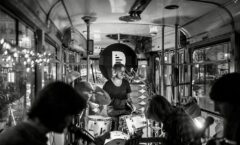
When Belgian singer-songwriter Essyla arrived at Daft Music Studios in the Belgian Ardennes for SABAM’s Summer Hit songwriting camp, Eurovision was nowhere on the horizon.
At the time, she was one of several emerging artists invited to spend a week writing and recording alongside producers, songwriters and musicians from across Belgium. The goal was not to create a Eurovision entry, it was simply to create.
What followed would eventually lead to Dancing on the Ice, the song that later represented Belgium at the Eurovision Song Contest 2026.
For Daft Studios, it became a perfect illustration of what songwriting camps can achieve when talented people are given the time, space and tools to work together.
What is a songwriting camp?
Songwriting camps have become an important part of the modern music industry. Over several days, artists, producers and songwriters work together in constantly evolving teams, developing new songs from initial ideas through to finished recordings.
The format is used throughout the industry, from major label pop releases to independent artist projects. Artists such as Rihanna, Dua Lipa, BTS and Ed Sheeran have all released music that emerged from collaborative songwriting camp environments.
What makes these camps unique is the intensity of the process. Writers who may never have met before are brought together, ideas move quickly between studios, and songs often evolve from a rough voice memo into a fully produced track within a matter of days.

Why Daft Music Studios works so well for songwriting camps
A successful writing camp requires more than rooms.
It requires a place where people can live, work and create together without interruption.
Located in the heart of the Belgian Ardennes, Daft Music Studios combine professional recording facilities with the accommodation and communal spaces of Daft Hotel, allowing entire teams of artists, producers and songwriters to stay on-site throughout the residency.
The setting encourages collaboration, but what makes Daft particularly valuable for songwriting camps is the level of production available from the moment an idea appears.
Most camps produce demos that are later re-recorded elsewhere. At Daft, songs can move far beyond the demo stage.
Equipped with a Rupert Neve Designs console, vintage Neumann microphones, an original EMT plate reverb and a dedicated Dolby Atmos control room, participants have access to the same tools used on professional releases. Instead of leaving with sketches, artists can leave with recordings that are already remarkably close to a finished record.
That combination of residential accommodation, creative focus and world-class recording infrastructure is what continues to attract songwriting camps, artist residencies and collaborative recording projects to the Belgian Ardennes.
From the Ardennes to Eurovision
Following the SABAM songwriting camp at Daft Music Studios, Dancing on the Ice continued its journey beyond the residency.
The song would eventually be selected as Belgium’s entry for the Eurovision Song Contest 2026, introducing Essyla’s music to audiences across Europe and beyond.
For Daft Music Studios, stories like this are always exciting, not because they guarantee a particular outcome, but because they reveal what can happen when artists are given the right environment to develop their work.
A week of collaboration in a recording studio in the Belgian Ardennes. A song written between sessions. A track refined using some of the best recording equipment available.
Then, months later, a performance on the world’s most watched musical event, proving that SABAM’s efforts to support songwriting in Belgium are paying off.
Sometimes the distance between a writing camp and Eurovision is shorter than it seems.